
The 4 Personal Spaces That Every Home Must Have
When we think about a home, we often focus on size, design style, or location.
But what truly defines the quality of a living space is something much deeper — how it supports the human experience.
A well-designed home doesn’t just shelter the body; it nourishes the mind, strengthens relationships, and restores the spirit.
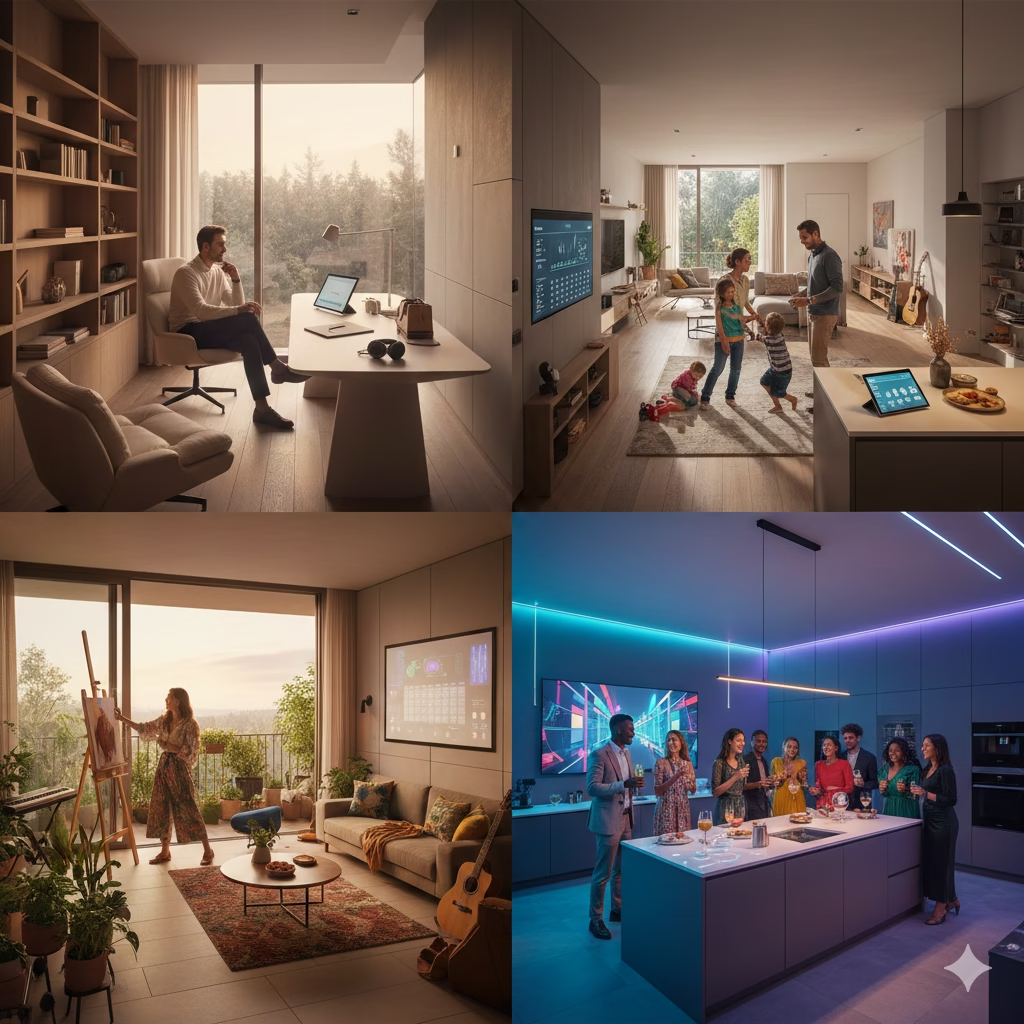
1. The Social Space – Where Life Happens Together (Living Room, Dining Area, Balcony)
This is the heart of connection in a home. It is where families gather, friends share stories, and memories are created. For extroverts, this space energises. For introverts, it provides a safe and controlled environment for carefully chosen connections.
A good social space should feel:
- Open and welcoming
- Flexible for different group sizes
- Comfortable for long conversations
- Naturally lit and breathable
In condos, this might be a combined living–dining area with floor-to-ceiling windows.
In landed homes, it may extend out to a patio, garden, or veranda — a seamless flow between indoor and outdoor living.
Emotionally, this space represents: Belonging, connection, celebration, and shared identity.
2. The Restoration Space – Where You Return to Yourself (Bedroom, Meditation Corner, Reading Zone)
This is your most private zone — the space where you disconnect from the external world and return to your inner self. Everyone, regardless of personality, needs a sanctuary to rest, think, dream, and heal.
The restoration space should be:
- Quiet and protected from noise
- Clutter-free and calming
- Designed for sleep and solitude
- Softly lit and well-ventilated
This is where your home shifts from being simply “a place,” to becoming truly yours.
Emotionally, this space represents: Safety, renewal, emotional processing, and self-connection.
3. The Productivity Space – Where Purpose Takes Form (Home Office, Study Desk, Creative Studio)
With hybrid work, side businesses, studying, and personal development now happening inside our homes, a dedicated productivity space is no longer a luxury — it is a necessity.
Whether it’s a full office room or a minimalist desk in the corner, this space should be:
- Well-organised
- Functional and ergonomic
- Free from major distractions
- Filled with inspiring elements
Extroverts may prefer an open, visible workspace; introverts may enjoy a tucked-away study with closed doors. The key is intentionality.
Emotionally, this space represents: Growth, ambition, mastery, and contribution.
4. The Nourishment Space – Where Energy is Created (Kitchen, Dining Area)
Food is not just fuel — it is emotional medicine, cultural story, and family bonding. The kitchen and dining spaces form the energetic core of the entire household.
An ideal nourishment space:
- Feels clean, bright and alive
- Encourages cooking and togetherness
- Has practical storage and flow
- Supports healthy rituals
This is where traditions are passed, conversations deepen, and the home is infused with warmth.
Emotionally, this space represents: Sustenance, togetherness, traditions, and love in action.
The 4 Persona by 16 MBTI Personalities
Across all 16 personality types, cultures, and lifestyles, four essential personal spaces consistently emerge as the most vital in any home. Whether you live in a compact condo or a spacious landed property, these four spaces form the emotional and functional foundation of a truly balanced life.
This article, is with the helps of ChatGPT & Gemini, the 16 MBTI personalities are mapped to their preferred living spaces/lifestyles.
To simplify for illustration, four persona categories (Solitary Strategist, Structured Guardian, Freedom Seeker, Social Navigator) are grouped.
| Persona | Preferred Angle | Property Hook |
|---|---|---|
| Solitary Strategist | Quiet + private | Sanctuary space |
| Structured Guardian | Safe + functional | Family-first layout |
| Freedom Seeker | Flexible + creative | Balcony/garden |
| Social Navigator | Open + impressive | Hosting/parties |
| MBTI Type | Core Focus | 🧍 Physical Space | 💬 Emotional Space | 👥 Social Space | Common Triggers | Best Respect Method |
|---|---|---|---|---|---|---|
| ISTJ | Order & routine | High | High | Low–medium | Surprise touch, disorganisation | Ask first, give structure |
| ISFJ | Duty & care | Medium | High | Medium | Emotional pressure | Reassure + gentle pacing |
| INFJ | Depth & intuition | Medium | Very high | Low | Overstimulation, shallow talk | Give privacy + depth |
| INTJ | Strategy & logic | Very high | Very high | Very low | Interruption, small talk | Be concise, respect silence |
| ISTP | Freedom & logic | High | Medium | Low | Emotional demands | Give autonomy & space |
| ISFP | Authentic & gentle | Medium | Very high | Low–medium | Criticism, forced schedules | Soft approach, personal time |
| INFP | Values & meaning | Medium | Extreme | Low | Confrontation, invasion | Respect ideals & boundaries |
| INTP | Knowledge & logic | High | High | Very low | Emotional chaos | Give thinking time |
| ESTP | Action & risk | Low–medium | Low | Very high | Boredom, restrictions | Offer space within action |
| ESFP | Fun & connection | Low | Medium | Very high | Coldness, rejection | Keep warmth & inclusion |
| ENFP | Ideas & freedom | Medium | Medium–high | Very high | Controlling rules | Flexible interaction |
| ENTP | Innovation & debate | Low–medium | Low | High | Predictability | Respect stimulation needs |
| ESTJ | Structure & control | Medium–high | Medium | High | Disorder, inefficiency | Give clear roles |
| ESFJ | Harmony & care | Low | Medium | Very high | Conflict, emotional distance | Frequent reassurance |
| ENFJ | Influence & connection | Low | Medium | Very high | Being ignored | Involve them actively |
| ENTJ | Power & strategy | Medium–high | Low–medium | Medium | Inefficiency | Get to the point |
About Myers-Briggs Type Indicator (MBTI)
Official MBTI Assessment: MBTIonline.com